Imagine your application is running perfectly. All servers are healthy, databases are responding, and users are happy.
Then suddenly, one of your servers goes down. Or perhaps a database becomes unavailable, a network connection fails, or an API stops responding.
Will your application survive?
This is exactly the question that Chaos Engineering tries to answer, before a real outage happens.
What Is Chaos Engineering?
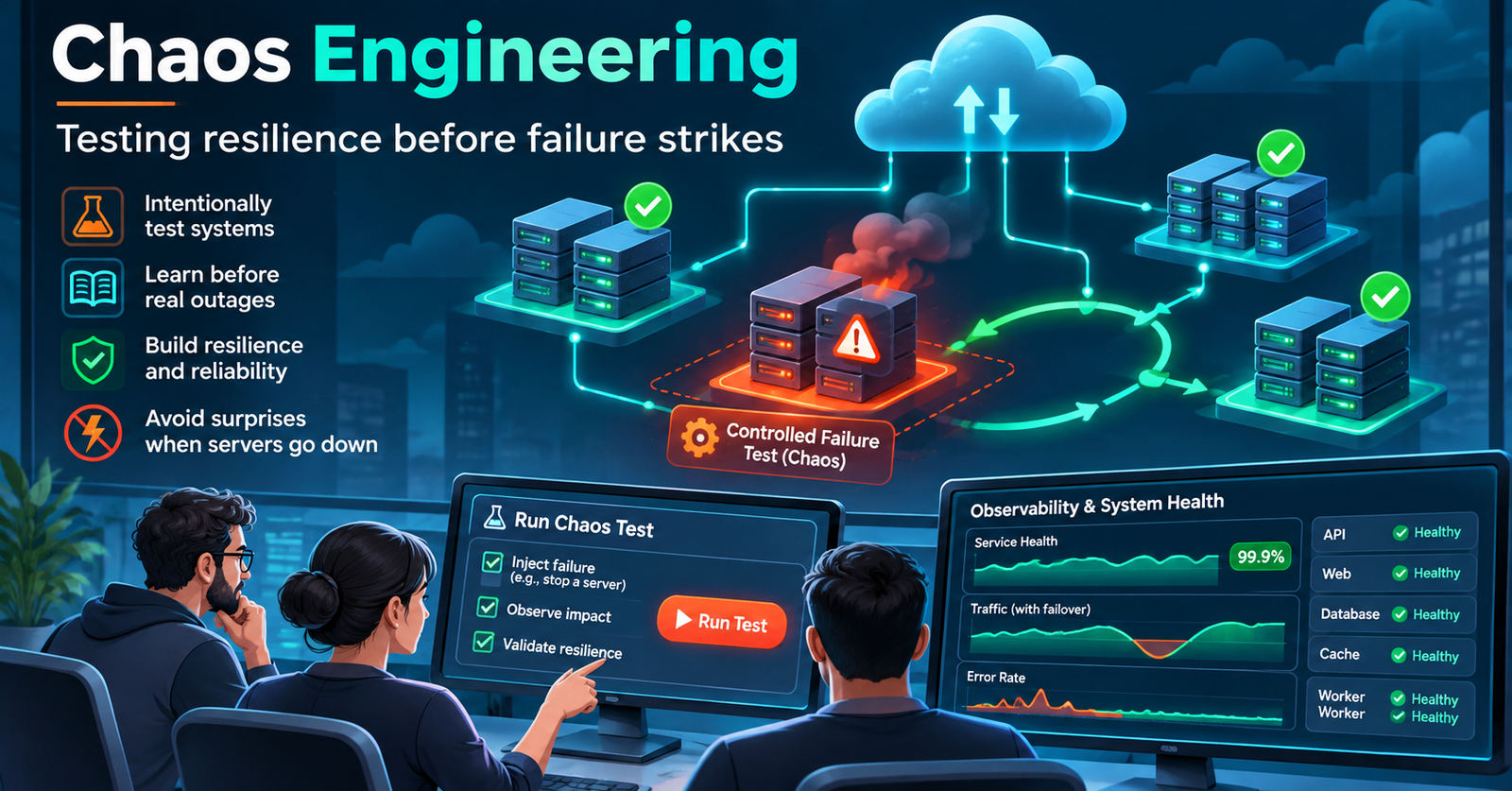
Chaos Engineering is the practice of intentionally introducing failures into a system to discover weaknesses before they cause real problems.
Instead of waiting for something to break unexpectedly, engineers simulate failures under controlled conditions and observe how their systems react.
For example:
- What happens if one of your servers suddenly shuts down?
- What if your database becomes unavailable for 30 seconds?
- What if an external API starts responding extremely slowly?
- What if network latency increases dramatically?
The goal isn’t simply to break things. It’s to verify that applications can recover, handle failures gracefully, and continue providing essential services.
How Netflix Helped Pioneer Chaos Engineering
The modern practice of Chaos Engineering is closely associated with Netflix.
Around 2010, while migrating its infrastructure to Amazon Web Services (AWS), Netflix faced an important challenge: How could it ensure that the failure of individual cloud servers wouldn’t interrupt streaming for millions of users?
Netflix engineers, including Greg Orzell, developed a tool called Chaos Monkey.
Its job was surprisingly simple: randomly shut down production server instances during working hours.
Yes, Netflix deliberately turned off parts of its own infrastructure!
The reasoning was that if engineers knew servers could disappear at any moment, they would design systems capable of automatically recovering from those failures.
Netflix later expanded the concept through its Simian Army, a collection of tools designed to simulate different infrastructure failures.
For example, if Netflix’s recommendation service becomes unavailable, the application should still work. Instead of personalized recommendations, it might display popular titles.
Users may lose a nonessential feature, but the core streaming experience continues.
Netflix open-sourced Chaos Monkey in 2012. In 2015, its Chaos Engineering team, led by Casey Rosenthal, helped formalize the practice through the Principles of Chaos Engineering.
It’s worth mentioning that intentional failure testing existed even earlier. Google’s Disaster Recovery Testing (DiRT) program, launched in 2006, was another important precursor.
How Can Teams Apply Chaos Engineering?
A small engineering team can start with a simple experiment:
1. Define normal behavior. Establish a baseline for availability, response times, error rates, and other important metrics.
2. Introduce a controlled failure. Shut down a noncritical server instance, simulate network latency, or temporarily make a dependency unavailable.
3. Observe the system. Does traffic automatically move to another server? Do requests fail? Are users affected? Do monitoring systems detect the problem?
4. Fix weaknesses. Improve retry mechanisms, timeouts, circuit breakers, redundancy, or automatic recovery.
5. Repeat the experiment. Verify that the improvements actually work.
Start in a testing environment, then gradually introduce carefully controlled production experiments when appropriate, using limited scope, monitoring, and clear rollback procedures.
Why Does It Matter?
Modern applications depend on increasingly complex distributed systems. Cloud infrastructure, microservices, databases, and third-party APIs introduce many potential points of failure.
Even when every individual component works correctly, the system as a whole can still behave unexpectedly.
Chaos Engineering helps teams discover those hidden dependencies, validate recovery mechanisms, improve incident response, and build confidence in their infrastructure.
The goal isn’t to prevent every failure. That’s impossible.
The goal is to build systems that can withstand failures without turning every incident into a major outage.
And sometimes, the best way to prepare for things breaking unexpectedly is to break them intentionally.
Checkout Netflix Chaos Monkey on Github: https://github.com/netflix/chaosmonkey
Leave a Reply