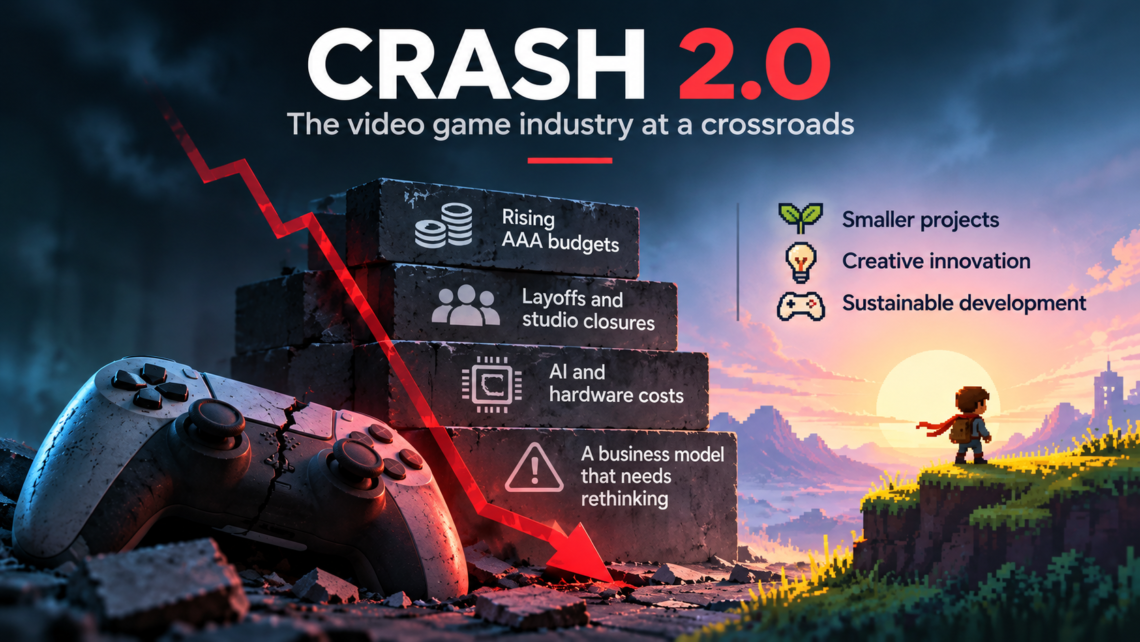
The video game industry is facing one of its most difficult periods in decades. Massive layoffs, studio closures, rising development costs, and increasingly expensive hardware have raised serious concerns about its future.
In Edge magazine’s November 2026 issue (#428), industry leaders, including Epic Games CEO Tim Sweeney, former PlayStation executive Shawn Layden, and veteran game designer Raph Koster, discuss what the magazine calls “Crash 2.0”, drawing parallels with the infamous video game crash of 1983.
🕹️ What happened in 1983?
In 1983, the North American video game market collapsed after becoming saturated with too many consoles and low-quality games. Companies like Atari rushed products to market, with the infamous E.T. the Extra-Terrestrial becoming a symbol of the crisis. Consumer confidence disappeared, sales plummeted, and numerous companies went out of business. The industry eventually recovered, largely thanks to Nintendo’s NES, introduced in North America in 1985.
What’s causing today’s crisis?
💰 Unsustainable AAA budgets: Modern AAA games can cost hundreds of millions of dollars and take many years to develop. Studios are taking enormous financial risks, often relying on blockbuster sales just to justify their investments.
📉 Layoffs and studio closures: According to figures discussed in Edge, more than 58,000 industry job losses are projected between 2022 and 2026. The crisis has hit traditional AAA studios in North America and Western Europe particularly hard.
🤖 The AI boom and hardware costs: AI companies are investing heavily in data centers, increasing competition for components such as RAM and storage. Meanwhile, expectations that AI will dramatically reduce game development costs may be overly optimistic.
🎯 A business model that needs rethinking: As development budgets grow, publishers become increasingly cautious about taking creative risks. This raises an important issue: the industry’s growing dependence on expensive blockbuster productions.
Unlike 1983, today’s crisis isn’t necessarily a collapse in demand for video games. It’s increasingly a crisis of how games are financed, developed, and sold.
I believe the solution isn’t necessarily bigger budgets, larger teams, or more advanced graphics. Perhaps the industry needs to rediscover the value of smaller, innovative projects, realistic budgets, and sustainable development.
After all, what makes a game memorable isn’t how much money was spent developing it, but how enjoyable and meaningful the experience is.
Inspired by Edge Magazine, Issue 428 (November 2026), “Redesigning Videogames” by Alex Spencer.